Why Belgravia, Kensington and Mayfair Are Absorbing 37% of London's Super-Prime Sales

Why Belgravia, Kensington and Mayfair Are Absorbing 37% of London's Super-Prime Sales

By Griskin Private Office

Published 8 June 2026 Reading time: 9 minutes

The Q1 2026 Savills super-prime data, published in early May, contained one figure that should have changed every conversation in Prime Central London property and largely did not. Of the 68 transactions above £5 million completed across all of London in the first three months of the year, 15 percent took place in Belgravia, 12 percent in Kensington, and 10 percent in Mayfair. Three postcodes absorbed 37 percent of the entire London super-prime market.

For Belgravia specifically, the 15 percent share is the highest concentration in a single London neighbourhood in five years.

This is not a passing seasonal pattern. It is a structural concentration of liquidity into the most defensible postcodes in Prime Central London, and it tells you everything you need to know about how the international buyer pool is currently thinking about risk. This piece sets out what is actually trading in each of the three postcodes, why the concentration is happening, what it means for buyers weighing a purchase in 2026, and the specific addresses where the data points to genuine value rather than reputation.

This is property commentary, not financial or investment advice. Specific decisions should be taken with qualified tax and legal advisors.

What the 37 percent figure actually tells you

The headline transaction data in Q1 2026 was bleak. 68 super-prime sales across all of London, 35 percent below Q1 2025 and 33 percent below Q1 2024. Total spend of £645 million, 42 percent below the prior year. The market is materially smaller than it was twelve months ago.

But within that smaller market, the geographic concentration has tightened sharply. In a normal market, the £5 million plus segment is distributed across roughly fifteen to twenty London postcodes, with no single area taking more than around 8 to 10 percent of activity. The Q1 2026 figures show three areas absorbing over a third of the market, with Belgravia alone at 15 percent.

What this tells you, plainly, is that the buyer who is still transacting in Prime London is being highly selective about where to deploy capital. Buyers are not spreading bets across the prime map. They are concentrating on the postcodes with the deepest historical liquidity, the most stable transaction histories, the strongest international name recognition, and the lowest political risk overhang.

For everyone outside those three postcodes, the implication is uncomfortable. Marylebone, Fitzrovia, Soho, parts of Pimlico and Westminster, even significant tranches of Chelsea and South Kensington are seeing weaker activity than the headline market data suggests. The headline number is being held up by three postcodes. The rest is thinner than agencies are acknowledging.

Belgravia: why it leads the table

Belgravia recorded the strongest super-prime performance of any London postcode in 2025 and has carried that momentum into 2026. According to Beauchamp Estates' 2026 Billionaire Buyers report, Belgravia saw eight £15 million plus sales in 2025, up from three in 2024. The 15 percent share of all £5 million plus London sales in Q1 2026 is the highest single-neighbourhood share recorded in five years.

The structural reasons matter. Belgravia operates within the Grosvenor Estate, which has owned and managed the area continuously since the 1820s. Architectural consistency, tenant covenant management, communal garden squares (Eaton Square, Belgrave Square, Chester Square), and the absence of speculative new-build redevelopment have produced a residential character that does not change materially across cycles. The postcode is what international UHNW buyers think of when they think of London, and the supply of stock that meets the standard is genuinely constrained.

According to Savills' Super Prime Supply update, just 40 percent of the £5 million plus new build pipeline in SW1W and SW1X is currently available for purchase, the lowest availability of any Prime Central London postcode. Demand depth combined with supply scarcity produces the transaction concentration the data is showing.

Where the activity is happening within Belgravia: Eaton Square remains the single most active address by capital value, particularly the south-side mansions with garden access. Wilton Crescent and Wilton Place have absorbed several significant 2026 transactions. Chester Square is selectively active. The Eaton Place leasehold market is moving on £15 to £25 million ticket sizes. The mews properties off Belgrave Square continue to trade at premium ceilings.

What the data does not tell you, but practitioners know, is that the Belgravia market in 2026 is heavily weighted toward turnkey product. Buyers are paying full prices for fully refurbished, planning-cleared properties and are walking away from refurbishment-required stock at the same price points. The premium for completed work is wider than at any point in the past decade.

Kensington: the steady second

Kensington took 12 percent of Q1 2026 super-prime sales, slightly ahead of its long-run share and consistent with its 2025 pattern. Within Kensington, two structurally different sub-markets are pulling weight in different directions.

The traditional Royal Borough core, the area south of Kensington High Street and east of Kensington Palace Gardens, is the more domestically owned of the two sub-markets and the more stable. Phillimore Gardens, Campden Hill Road, Kensington Square, and the larger family houses on Stafford Terrace and Holland Street are the addresses where £8 to £20 million family acquisitions are completing. The buyer profile is heavily UK domestic with a meaningful international layer, often relocating for school placement at the West London independent schools.

Kensington Palace Gardens itself, the so-called Billionaire's Row, remains a thin and specialist market. Most of the houses are diplomatic residences or owner-occupied by individuals with multi-decade holding periods. When properties do transact, they transact privately and the pricing is rarely publicly disclosed. Q1 2026 saw at least one transaction at the upper end of this market but precise reporting was not available.

The Holland Park area, contiguous with Kensington but more aesthetically distinct, has absorbed a meaningful share of the buyer pool that historically defaulted to Notting Hill in earlier cycles. The crescents and the larger Phillimore Estate houses west of Holland Park Avenue have seen sustained activity through Q1.

What the data does not capture: Kensington's £5 to £10 million flat market is genuinely soft. The transaction activity skewing the postcode's headline figure is concentrated in the larger family houses, not the apartment market.

Mayfair: the third place in the league table

Mayfair took 10 percent of Q1 2026 super-prime sales. The number is broadly in line with the postcode's long-run share, but the composition is interesting.

According to Beauchamp Estates' 2026 review, Mayfair specifically experienced a shortage of turnkey stock through 2025 and limited deal volumes despite strong underlying buyer demand. The pattern has continued into 2026. The Mayfair £15 million plus market in 2025 produced only 5 transactions, down from 9 in the prior year, despite deep buyer interest. The constraint is supply, not demand.

Where Mayfair activity is happening: the area east of Berkeley Square (Charles Street, Hill Street, Hays Mews) for traditional lateral apartments and townhouses. Mount Street and the surrounding streets for retail-adjacent residential. Park Lane for high-floor apartments with park views. The Grosvenor Square area for institutional-quality apartments. The Mayfair mews market remains active across Lees Place, Adams Row, Bourdon Street, and Three Kings Yard.

What is genuinely scarce in Mayfair right now is fully refurbished lateral apartment stock above 3,000 square feet in established buildings. When this stock comes to market, it transacts. When it does not, the pipeline thins. Beauchamp's 2026 commentary specifically flagged Mayfair turnkey inventory as structurally undersupplied, with developers who can deliver this product likely to clear quickly.

What about Knightsbridge?

Knightsbridge is not in the Q1 2026 top three by transaction count, which is itself worth noting. The postcode remains active and the headline new-build pipeline (One Hyde Park, the Knightsbridge Apartments, and several private mansions on Knightsbridge proper) continues to trade, but the volume in Q1 was thinner than the three postcodes ahead of it.

The reason is structural. Knightsbridge's super-prime stock is more heavily weighted toward new-build apartment product than Belgravia's. New build has been the segment most affected by the broader market correction, with buyers preferring the architectural permanence of Belgravian stucco and Kensington's traditional family houses to the new-build apartment format. Coutts has been actively directing private bank clients into Knightsbridge on a deep-value thesis (the area is trading approximately 29.5 percent below 2014 peak), and the Q2 and Q3 data will likely show that thesis playing out.

For buyers, Knightsbridge in 2026 may actually represent better value than Belgravia for an equivalent quality of stock. The 37 percent concentration is being driven partly by reputation and partly by the specific stock that is moving. Knightsbridge stock is genuinely available at lower entry points relative to peak.

What this concentration means for buyers

Three observations matter most.

The first is that buying outside the three postcodes is now structurally riskier than at any point in the past decade for an international buyer. Liquidity outside Belgravia, Kensington and Mayfair is genuinely thinner. If your exit strategy depends on selling within a normal marketing window, you should be specifically aware that postcodes that traded freely in 2018 to 2021 may not trade as readily in 2027 to 2030.

The second is that within the three postcodes, the premium for the right product is widening. Turnkey, planning-cleared, fully refurbished stock is commanding premiums over comparable refurbishment-required stock that are significantly higher than at any point I can recall. The buyer who is willing to take on a refurbishment project in Belgravia or Mayfair is now paying meaningfully less per square foot for the underlying property. For buyers with the appetite and capital for the works, this is genuinely the strongest entry point in years.

The third is that the concentration is itself information about the macro view. The buyer pool that is still transacting is the one that has the deepest conviction in London's long-term recovery, and it is voting with its capital. They are not buying in Marylebone or Fitzrovia or Pimlico in this cycle. They are buying in Belgravia, Kensington and Mayfair. For buyers considering a Prime London entry, the question worth asking honestly is whether you share that conviction, and whether the postcode you are considering is one the most-disciplined capital is currently choosing.

Where the value actually sits in 2026

For UK-resident buyers willing to take a position before the political uncertainty resolves, the deepest value is in fully refurbished Belgravia stock at the £8 to £15 million level. Liquidity is concentrating here, supply is constrained, and the buyer pool is the deepest in London. The premium over comparable Marylebone or Fitzrovia stock is real but defensible.

For non-resident buyers facing the proposed mansion tax non-resident premium, Kensington's domestic-buyer-weighted family house market is the safest position. The premium is less exposed to the policy risk because the buyer pool is more domestic. The Phillimore Estate area specifically offers turnkey stock with established planning records.

For buyers seeking the deepest discount from peak with willingness to accept apartment-format stock, Knightsbridge is genuinely the strongest value. The Coutts thesis on this area is correct and the market has not yet rotated into it.

For Mayfair, the right play is a developer-to-buyer relationship for fully refurbished lateral apartments above 3,000 square feet. The market is undersupplied, the demand exists, and the buyer who is in early on a developer relationship can secure stock that would not be openly marketed.

The buyers who should not be in Prime London right now are those who want a passive hold without engaging with the specific dynamics of each postcode. The market is too geographically concentrated, too policy-exposed, and too operationally demanding for a "buy anywhere in PCL and wait" strategy to work over the next two to three years.

The bottom line

Three postcodes are absorbing 37 percent of London's super-prime market. The concentration is structural, not seasonal, and it reflects the disciplined selectivity of the buyer pool that is still transacting. For serious buyers in 2026, the question is not whether to buy Prime London but where specifically within Prime London, and the data is unambiguous about which postcodes the smart money is choosing.

This is the most concentrated PCL market I have seen in a decade. Within the right three postcodes, the right product, and the right negotiating discipline, the entry conditions are excellent. Outside them, the risk profile has shifted in ways most buyers have not yet absorbed.

If you are considering a Prime Central London or Surrey acquisition in the current market and want a candid view on which specific postcodes and buildings make sense for your brief, you can reach Griskin at info@griskin.co.uk or +44 7427 533 006. Initial conversations are confidential and without obligation, in English or Russian.
Go back

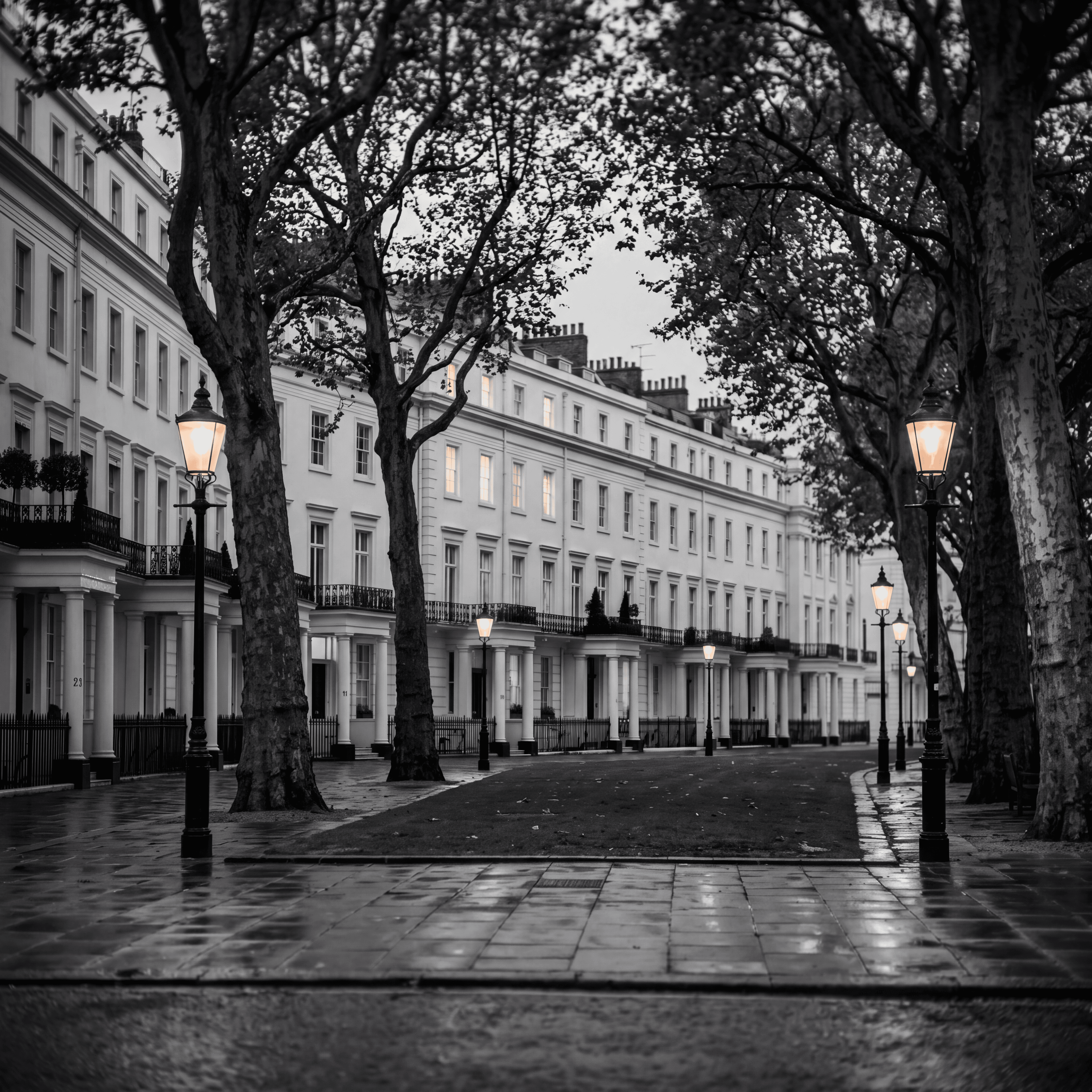
Eaton Square in Belgravia at dusk with white stucco mansions and illuminated windows, illustrating the concentration of London super-prime sales in three postcodes, monochrome editorial photograph

Belgravia super-prime sales 2026 • Where to buy in Prime Central London • Kensington property market • Mayfair turnkey apartments • Q1 2026 PCL transaction data • Belgravia Knightsbridge liquidity • PCL buyer-side advisory

Why Belgravia, Kensington and Mayfair Are Absorbing 37% of London's Super-Prime Sales

By Griskin Private Office

Published 8 June 2026 Reading time: 9 minutes

The Q1 2026 Savills super-prime data, published in early May, contained one figure that should have changed every conversation in Prime Central London property and largely did not. Of the 68 transactions above £5 million completed across all of London in the first three months of the year, 15 percent took place in Belgravia, 12 percent in Kensington, and 10 percent in Mayfair. Three postcodes absorbed 37 percent of the entire London super-prime market.

For Belgravia specifically, the 15 percent share is the highest concentration in a single London neighbourhood in five years.

This is not a passing seasonal pattern. It is a structural concentration of liquidity into the most defensible postcodes in Prime Central London, and it tells you everything you need to know about how the international buyer pool is currently thinking about risk. This piece sets out what is actually trading in each of the three postcodes, why the concentration is happening, what it means for buyers weighing a purchase in 2026, and the specific addresses where the data points to genuine value rather than reputation.

This is property commentary, not financial or investment advice. Specific decisions should be taken with qualified tax and legal advisors.

What the 37 percent figure actually tells you

The headline transaction data in Q1 2026 was bleak. 68 super-prime sales across all of London, 35 percent below Q1 2025 and 33 percent below Q1 2024. Total spend of £645 million, 42 percent below the prior year. The market is materially smaller than it was twelve months ago.

But within that smaller market, the geographic concentration has tightened sharply. In a normal market, the £5 million plus segment is distributed across roughly fifteen to twenty London postcodes, with no single area taking more than around 8 to 10 percent of activity. The Q1 2026 figures show three areas absorbing over a third of the market, with Belgravia alone at 15 percent.

What this tells you, plainly, is that the buyer who is still transacting in Prime London is being highly selective about where to deploy capital. Buyers are not spreading bets across the prime map. They are concentrating on the postcodes with the deepest historical liquidity, the most stable transaction histories, the strongest international name recognition, and the lowest political risk overhang.

For everyone outside those three postcodes, the implication is uncomfortable. Marylebone, Fitzrovia, Soho, parts of Pimlico and Westminster, even significant tranches of Chelsea and South Kensington are seeing weaker activity than the headline market data suggests. The headline number is being held up by three postcodes. The rest is thinner than agencies are acknowledging.

Belgravia: why it leads the table

Belgravia recorded the strongest super-prime performance of any London postcode in 2025 and has carried that momentum into 2026. According to Beauchamp Estates' 2026 Billionaire Buyers report, Belgravia saw eight £15 million plus sales in 2025, up from three in 2024. The 15 percent share of all £5 million plus London sales in Q1 2026 is the highest single-neighbourhood share recorded in five years.

The structural reasons matter. Belgravia operates within the Grosvenor Estate, which has owned and managed the area continuously since the 1820s. Architectural consistency, tenant covenant management, communal garden squares (Eaton Square, Belgrave Square, Chester Square), and the absence of speculative new-build redevelopment have produced a residential character that does not change materially across cycles. The postcode is what international UHNW buyers think of when they think of London, and the supply of stock that meets the standard is genuinely constrained.

According to Savills' Super Prime Supply update, just 40 percent of the £5 million plus new build pipeline in SW1W and SW1X is currently available for purchase, the lowest availability of any Prime Central London postcode. Demand depth combined with supply scarcity produces the transaction concentration the data is showing.

Where the activity is happening within Belgravia: Eaton Square remains the single most active address by capital value, particularly the south-side mansions with garden access. Wilton Crescent and Wilton Place have absorbed several significant 2026 transactions. Chester Square is selectively active. The Eaton Place leasehold market is moving on £15 to £25 million ticket sizes. The mews properties off Belgrave Square continue to trade at premium ceilings.

What the data does not tell you, but practitioners know, is that the Belgravia market in 2026 is heavily weighted toward turnkey product. Buyers are paying full prices for fully refurbished, planning-cleared properties and are walking away from refurbishment-required stock at the same price points. The premium for completed work is wider than at any point in the past decade.

Kensington: the steady second

Kensington took 12 percent of Q1 2026 super-prime sales, slightly ahead of its long-run share and consistent with its 2025 pattern. Within Kensington, two structurally different sub-markets are pulling weight in different directions.

The traditional Royal Borough core, the area south of Kensington High Street and east of Kensington Palace Gardens, is the more domestically owned of the two sub-markets and the more stable. Phillimore Gardens, Campden Hill Road, Kensington Square, and the larger family houses on Stafford Terrace and Holland Street are the addresses where £8 to £20 million family acquisitions are completing. The buyer profile is heavily UK domestic with a meaningful international layer, often relocating for school placement at the West London independent schools.

Kensington Palace Gardens itself, the so-called Billionaire's Row, remains a thin and specialist market. Most of the houses are diplomatic residences or owner-occupied by individuals with multi-decade holding periods. When properties do transact, they transact privately and the pricing is rarely publicly disclosed. Q1 2026 saw at least one transaction at the upper end of this market but precise reporting was not available.

The Holland Park area, contiguous with Kensington but more aesthetically distinct, has absorbed a meaningful share of the buyer pool that historically defaulted to Notting Hill in earlier cycles. The crescents and the larger Phillimore Estate houses west of Holland Park Avenue have seen sustained activity through Q1.

What the data does not capture: Kensington's £5 to £10 million flat market is genuinely soft. The transaction activity skewing the postcode's headline figure is concentrated in the larger family houses, not the apartment market.

Mayfair: the third place in the league table

Mayfair took 10 percent of Q1 2026 super-prime sales. The number is broadly in line with the postcode's long-run share, but the composition is interesting.

According to Beauchamp Estates' 2026 review, Mayfair specifically experienced a shortage of turnkey stock through 2025 and limited deal volumes despite strong underlying buyer demand. The pattern has continued into 2026. The Mayfair £15 million plus market in 2025 produced only 5 transactions, down from 9 in the prior year, despite deep buyer interest. The constraint is supply, not demand.

Where Mayfair activity is happening: the area east of Berkeley Square (Charles Street, Hill Street, Hays Mews) for traditional lateral apartments and townhouses. Mount Street and the surrounding streets for retail-adjacent residential. Park Lane for high-floor apartments with park views. The Grosvenor Square area for institutional-quality apartments. The Mayfair mews market remains active across Lees Place, Adams Row, Bourdon Street, and Three Kings Yard.

What is genuinely scarce in Mayfair right now is fully refurbished lateral apartment stock above 3,000 square feet in established buildings. When this stock comes to market, it transacts. When it does not, the pipeline thins. Beauchamp's 2026 commentary specifically flagged Mayfair turnkey inventory as structurally undersupplied, with developers who can deliver this product likely to clear quickly.

What about Knightsbridge?

Knightsbridge is not in the Q1 2026 top three by transaction count, which is itself worth noting. The postcode remains active and the headline new-build pipeline (One Hyde Park, the Knightsbridge Apartments, and several private mansions on Knightsbridge proper) continues to trade, but the volume in Q1 was thinner than the three postcodes ahead of it.

The reason is structural. Knightsbridge's super-prime stock is more heavily weighted toward new-build apartment product than Belgravia's. New build has been the segment most affected by the broader market correction, with buyers preferring the architectural permanence of Belgravian stucco and Kensington's traditional family houses to the new-build apartment format. Coutts has been actively directing private bank clients into Knightsbridge on a deep-value thesis (the area is trading approximately 29.5 percent below 2014 peak), and the Q2 and Q3 data will likely show that thesis playing out.

For buyers, Knightsbridge in 2026 may actually represent better value than Belgravia for an equivalent quality of stock. The 37 percent concentration is being driven partly by reputation and partly by the specific stock that is moving. Knightsbridge stock is genuinely available at lower entry points relative to peak.

What this concentration means for buyers

Three observations matter most.

The first is that buying outside the three postcodes is now structurally riskier than at any point in the past decade for an international buyer. Liquidity outside Belgravia, Kensington and Mayfair is genuinely thinner. If your exit strategy depends on selling within a normal marketing window, you should be specifically aware that postcodes that traded freely in 2018 to 2021 may not trade as readily in 2027 to 2030.

The second is that within the three postcodes, the premium for the right product is widening. Turnkey, planning-cleared, fully refurbished stock is commanding premiums over comparable refurbishment-required stock that are significantly higher than at any point I can recall. The buyer who is willing to take on a refurbishment project in Belgravia or Mayfair is now paying meaningfully less per square foot for the underlying property. For buyers with the appetite and capital for the works, this is genuinely the strongest entry point in years.

The third is that the concentration is itself information about the macro view. The buyer pool that is still transacting is the one that has the deepest conviction in London's long-term recovery, and it is voting with its capital. They are not buying in Marylebone or Fitzrovia or Pimlico in this cycle. They are buying in Belgravia, Kensington and Mayfair. For buyers considering a Prime London entry, the question worth asking honestly is whether you share that conviction, and whether the postcode you are considering is one the most-disciplined capital is currently choosing.

Where the value actually sits in 2026

For UK-resident buyers willing to take a position before the political uncertainty resolves, the deepest value is in fully refurbished Belgravia stock at the £8 to £15 million level. Liquidity is concentrating here, supply is constrained, and the buyer pool is the deepest in London. The premium over comparable Marylebone or Fitzrovia stock is real but defensible.

For non-resident buyers facing the proposed mansion tax non-resident premium, Kensington's domestic-buyer-weighted family house market is the safest position. The premium is less exposed to the policy risk because the buyer pool is more domestic. The Phillimore Estate area specifically offers turnkey stock with established planning records.

For buyers seeking the deepest discount from peak with willingness to accept apartment-format stock, Knightsbridge is genuinely the strongest value. The Coutts thesis on this area is correct and the market has not yet rotated into it.

For Mayfair, the right play is a developer-to-buyer relationship for fully refurbished lateral apartments above 3,000 square feet. The market is undersupplied, the demand exists, and the buyer who is in early on a developer relationship can secure stock that would not be openly marketed.

The buyers who should not be in Prime London right now are those who want a passive hold without engaging with the specific dynamics of each postcode. The market is too geographically concentrated, too policy-exposed, and too operationally demanding for a "buy anywhere in PCL and wait" strategy to work over the next two to three years.

The bottom line

Three postcodes are absorbing 37 percent of London's super-prime market. The concentration is structural, not seasonal, and it reflects the disciplined selectivity of the buyer pool that is still transacting. For serious buyers in 2026, the question is not whether to buy Prime London but where specifically within Prime London, and the data is unambiguous about which postcodes the smart money is choosing.

This is the most concentrated PCL market I have seen in a decade. Within the right three postcodes, the right product, and the right negotiating discipline, the entry conditions are excellent. Outside them, the risk profile has shifted in ways most buyers have not yet absorbed.

If you are considering a Prime Central London or Surrey acquisition in the current market and want a candid view on which specific postcodes and buildings make sense for your brief, you can reach Griskin at info@griskin.co.uk or +44 7427 533 006. Initial conversations are confidential and without obligation, in English or Russian.

Go back

Eaton Square in Belgravia at dusk with white stucco mansions and illuminated windows, illustrating the concentration of London super-prime sales in three postcodes, monochrome editorial photograph

Belgravia super-prime sales 2026 • Where to buy in Prime Central London • Kensington property market • Mayfair turnkey apartments • Q1 2026 PCL transaction data • Belgravia Knightsbridge liquidity • PCL buyer-side advisory

Independent buyer-side and tenant-side property advisory.

© 2026 Griskin Holdings Ltd . Registered in England No. 13129659 , Registered Office:132A West Hill, London, SW15 2UE . All rights reserved.

Independent buyer-side and tenant-side property advisory.

© 2026 Griskin Holdings Ltd . Registered in England No. 13129659 , Registered Office:132A West Hill, London, SW15 2UE . All rights reserved.